Showing posts with label political economy. Show all posts

Thursday, January 28, 2016

China Rewrites the Global Rules

Despite worries over the end of the Chinese economic miracle and harder times because of the aftershocks of the 2008 financial crisis, global rebalancing is happening — and quickly.
by Philip S Golub
The International Monetary Fund’s executive board announced on 30 November that the Chinese currency, the renminbi (RMB) or yuan, would soon be included in the basket of currencies that make up its Special Drawing Rights (SDR), beside the US dollar, the euro, the British pound and the yen.


The decision recognised the growing role of the Chinese currency in international trade settlements. Since the launch in 2009 of a pilot programme for cross-border RMB trade settlements in Asia, the share of Chinese trade settled in RMB has risen from 3.2% to 25%, and should, according to the Financial Times, soon reach 46% (1). Offshore centres clearing the currency have been set up in Hong Kong, Singapore, Taiwan, London and Frankfurt. The RMB is still far from world reserve status, requiring full convertibility and complete capital market liberalisation, which China is not ready for and carries significant risks. But the RMB’s rise is a “momentous event in [...] international finance”, according to a former IMF economist (2) — the beginning of a slow shift towards a tripolar world monetary system no longer exclusively centred in the West.
“Great powers have great currencies,” says Robert Mundell (3). Like the gradual rise of the dollar to reserve status in the early 20th century, the internationalisation of the RMB is part of the larger story of China’s re-emergence as a semi-autonomous core of the world economy, and as the primary driver of the movement of East-West and North-South rebalancing that is a key feature of current world politics. China’s share of world GDP, in purchasing power parity (PPP), has risen in 40 years from less than 2% to over 16%, ahead of the US. Though Chinese economic growth declined with the “great recession” after the 2008 crisis, average per capita GDP (PPP) is now expected to increase within a few years (from $9,800 to $16,000, against $250 in 1980). Longer-range projections, which showed a growth trajectory similar to Japan in the late 20th century, suggest that per capita GDP will reach current Japanese or European levels by the mid-21st century. China is gradually regaining a position in the world economy in keeping with its demographic weight.

                                           Key South-South actor

It has become the core of South-South trade and investment linkage, supplanted Japan and the US as the leading trade partner of nearly all East Asian countries, and become a crucial actor in South American, African and South Asian trade. China is now Brazil’s leading trade partner, ahead of the US. There are similar trends in Chile, Argentina and smaller South American economies. South Africa’s export share to China has risen from 1.8% in 1998 to over 12%, while imports have risen from 3% to 15%. Indian exports to China have risen from 2.9% to over 10%, and imports from 2% to 12%.

This points to a re-patterning of the geography of world trade, and an East Asia-centric South-South trading system, with China at the core. Thanks to new regional and transcontinental linkages centred in East Asia, South-South trade (SST) has expanded more rapidly over 20 years than global trade. In 2013 SST was 25% of world trade, 21% of manufacturing exports, and 25% of exports of manufactures with medium and high technological intensity. Trade between developed countries fell from 46% to less than 30%. The result is a reduction of traditional single-market dependency in Latin American, sub-Saharan and Southeast Asian countries on Europe and the US. This has been accompanied, particularly in East Asia, by industrial upgrading: the “developing” world’s share of manufacturing value-added has risen from 8.8% to nearly 30%, and of merchandise trade from 25% to 47%.
China’s re-emergence has begun to alter the vertical North-South relations of the age of western empire and industry. This generates new dependencies: when China sneezes, emerging country partners catch colds — as with the current downturns for exporters of primary goods because of China’s slowing growth. The impact of the global crisis on China evinces the need for a sustainable development strategy focused on domestic improvements rather than export growth. Even so, we are witnessing a structural change in the global economic and political hierarchy.

                                       Bye-bye Bretton Woods?

Politics has lagged behind economics, but a gradual reordering of world politics is visible in the growing voice of the South in organisations and clubs (G20), its activism in world politics, and new international institution-building efforts bypassing traditional centres of authority. Frustrated by the slow pace of change, notably in the IMF and World Bank, China has been leading the effort of global South countries to create a new system to govern the world economy. In 2013 Brazil, Russia, India, China and South Africa (the BRICS) set up the New Development Bank (NDB),headquartered in Shanghai, with a capital base (money paid in and pledged) of $100bn; this will combine investment and monetary functions, serving as a lending institution for infrastructure development projects as well as a reserve facility for balance of payments issues. In 2014 China founded the Asian Infrastructure Investment Bank (AIIB), which, like the NDB, has a $100bn capital base (the Japanese-led Asian Development Bank has $160bn, the World Bank $220bn).

Full-text available at:


Wednesday, October 21, 2015

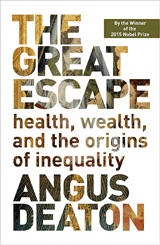
The Great Escape: Health, Wealth, and the Origins of Inequality

Angus Deaton, Winner of the 2015 Nobel Prize in Economics
bookjacket
The world is a better place than it used to be. People are healthier, wealthier, and live longer. Yet the escapes from destitution by so many has left gaping inequalities between people and nations. In The Great Escape, Angus Deaton--one of the foremost experts on economic development and on poverty--tells the remarkable story of how, beginning 250 years ago, some parts of the world experienced sustained progress, opening up gaps and setting the stage for today's disproportionately unequal world. Deaton takes an in-depth look at the historical and ongoing patterns behind the health and wealth of nations, and addresses what needs to be done to help those left behind.

Deaton describes vast innovations and wrenching setbacks: the successes of antibiotics, pest control, vaccinations, and clean water on the one hand, and disastrous famines and the HIV/AIDS epidemic on the other. He examines the United States, a nation that has prospered but is today experiencing slower growth and increasing inequality. He also considers how economic growth in India and China has improved the lives of more than a billion people. Deaton argues that international aid has been ineffective and even harmful. He suggests alternative efforts--including reforming incentives to drug companies and lifting trade restrictions--that will allow the developing world to bring about its own Great Escape.

Demonstrating how changes in health and living standards have transformed our lives, The Great Escape is a powerful guide to addressing the well-being of all nations.

Angus Deaton, winner of the 2015 Nobel Prize in economics, is the Dwight D. Eisenhower Professor of Economics and International Affairs in the Woodrow Wilson School of Public and International Affairs and the Economics Department at Princeton University. His many books include The Analysis of Household Surveys and Economics and Consumer Behavior. He is a past president of the American Economic Association.

Reviews:
"If you want to learn about why human welfare overall has gone up so much over time, you should read The Great Escape: Health, Wealth, and the Origins of Inequality."--Bill Gates

"[O]ne of the most succinct guides to conditions in today's world. . . . The story Deaton tells--the most inspiring human story of all--should give all of us reason for optimism, so long as we are willing to listen to its moral."--David Leonhardt, New York Times Book Review

"[A]n illuminating and inspiring history of how mankind's longevity and prosperity have soared to breathtaking heights in modern times. . . . [Deaton's] book gives a stirring overview of the economic progress and medical milestones that, starting with the Industrial Revolution and accelerating after World War II, have caused life expectancies to soar."--Fred Andrews, New York Times
"[A]n engaging and sure-footed guide to the 'endless dance between progress and inequality . . .'"--Martha C. Nussbaum, New Republic

"Is the world becoming a fairer as well as a richer place? Few economists are better equipped to answer this question than Angus Deaton of Princeton University, who has thought hard about measuring international well-being and is not afraid to roam through history. Refreshingly, Mr Deaton also reaches beyond a purely economic narrative to encompass often neglected dimensions of progress such as better health. . . . [T]he theme requires a big canvas and bold brushwork, and Mr Deaton capably offers both."--Economist

"[E]loquently written and deeply researched. . . . For those interested in world poverty, it is unquestionably the most important book on development assistance to appear in a long time."--Kenneth Rogoff, Project Syndicate


Table of Contents:
Preface ix
Introduction: What This Book Is About 1
1 The Wellbeing of the World 23
PART I LIFE AND DEATH
2 From Prehistory to 1945 59
3 Escaping Death in the Tropics 101
4 Health in the Modern World 126
PART II MONEY
5 Material Wellbeing in the United States 167
6 Globalization and the Greatest Escape 218
PART III HELP
7 How to Help Those Left Behind 267
Postscript: What Comes Next? 325
Notes 331
Index 351


http://press.princeton.edu/titles/10054.html

Monday, February 10, 2014

The Precariat: Emergence of a global ‘dangerous class’?

Jan Breman, New Left Review 84 (11-12 2013)

Guy Standing, The Precariat: The New Dangerous Class, Bloomsbury Academic: London 2011
Up till the 1970s, the notion that the Rest would follow in the footsteps of the West was intrinsic to the dominant development paradigm. [1] Through industrialization and urbanization, the ‘underdeveloped world’ would replicate the experience of the advanced economies in the nineteenth century: growing employment in manufacturing, rising living standards, mass consumption. If there were not, as yet, many industrial jobs available for the land-poor migrants who began flocking to the cities of Latin America, Africa, the Indian Subcontinent and Southeast Asia, where land reform had been negligible, the consensus was that urban life itself would help them in their search for employment. For the time being they had to make do with whatever low-paid work was accessible to them, as waged hands or self-employed, living in makeshift shelters on the city outskirts or on vacant land. The burgeoning informal sector was at first seen as a zone of transition, a buffer that would disappear as labour was absorbed by the dynamics of industrialization into a growing formal economy. This upward mobility turned out to be a rare occurrence, however, and millions remained stuck in the informal economy that they had helped to build, or drifting back and forth between the slums of the urban periphery and the impoverished rural hinterland, forming a vast stratum of precarious labour.

Now, it seems, it is the West that is following the Rest when it comes to the growing insecurity of work conditions. With every recession since the 1970s, prolonged episodes of high unemployment, privatizations and public-sector cutbacks have served to weaken the position of labour in North America, Europe and Japan; trade-union movements were hollowed out by the shrinkage of the industrial workforce, through factory re-location or robotization, and the growth of the non-unionized service and retail sectors; the rise of China, the entry of hundreds of millions of low-paid workers into the world workforce and the globalization of trade helped to depress wages and working conditions further. Part-time and short-contract work has been on the rise, along with that ambiguous category, self-employment. An extensive literature has now grown up around the issue of informal and precarious labour in the advanced economies. What relation does this bear to the condition of workers outside the OECD, where the vast mass of humanity is located? Is it possible to generalize about global trends, or do specific economies need to be examined comparatively? What are the political implications of changing workforce patterns? Are we in fact talking about a new phenomenon?
An economist at the International Labour Organization from 1975 until 2006, Guy Standing should be well placed to address these questions. Though his recent work has focused largely on the condition of labour in the Western world, he is well acquainted with the precarious nature of work and life for most people in the global South; he has been a presence at international seminars and conferences discussing the vulnerability of workers in the informal economy for many decades. His first publication with the ILO was a scholarly treatise on labour-force participation in low-income countries in 1978, followed by labour-force studies on Jamaica, Guyana, Malaysia, Thailand and elsewhere. In the mid-80s, Standing was responsible for a series of ILO analyses of labour-market ‘flexibility’ in the OECD countries, which took a sceptical view of neoliberal nostrums while accepting that the capitalist economies had entered a new era, marked by unemployment and fiscal crises. In the early 90s he switched to Russia, editing In Search of Flexibility: The New Soviet Labour Market (1991) for the ILO, followed by post-Apartheid South Africa withRestructuring the Labour Market: The South African Challenge (1996).
Three more general books have followed over the last fifteen years: Global Labour Flexibility(1999), Beyond the New Paternalism (2002) and Work after Globalization (2009) all addressed similar themes, looking at the transition from the post-war era of ‘statutory regulation’ to that of post-1975 ‘market regulation’ from a critical Polanyian perspective, with data drawn mainly from the advanced-capitalist world. Standing defined seven forms of labour security—adequate opportunities, protection against dismissal, barriers to skill dilution, health and safety regulations, training, stable income, representation—all of which were being eroded in the new era. He identified six components of ‘social income’—direct production, wages, community support, company benefits, state provision, private/rentier income—each of which was shifting in different ways for different groups. Globalization, he argued, was creating a new class landscape, with seven clearly delineated social strata. In 2002, Beyond the New Paternalism identified ‘flexiworkers’ as a crucial group; seven years later, Work after Globalization replaced the term ‘flexiworkers’ with ‘precariat’, which by then was already in relatively wide circulation. Standing argued by way of remedy, as he has done since the mid-80s, for a new ‘politics of paradise’, underwritten by a universal basic-income grant.
His latest work, The Precariat, aims in part to rehearse these themes for what Standing calls ‘the lay reader’. But it also introduces a new claim: that there is now a new class in the making, a ‘global precariat’. Standing argues once again that the dynamics of globalization, along with concerted government drives for labour flexibility—a euphemism he abhors—have led to a fragmentation of older class divisions. He locates the ‘precariat’ in the bottom half of what is now a seven-class system. Above it are the elite (‘a tiny number of absurdly rich global citizens lording it over the universe with their billions of dollars, able to influence governments everywhere’); the ‘salariat’, well entrenched in large corporations and government administration, still enjoying stable full-time employment, pensions and paid holidays; a smaller segment of skilled ‘proficians’, highly rewarded own-account consultants and specialists; and the rump of the old working class, about which Standing is particularly scathing. Below the ‘precariat’ come the unemployed and the lowest class of all, ‘socially ill misfits living off the dregs of society’.
The ‘precariat’ in Standing’s definition consists of all those who are engaged in insecure forms of labour that are unlikely to help them build a desirable identity or career: temporary and part-time workers, sub-contracted labour, call-centre employees, many interns. It might be thought that these were classic proletarians: stripped of the means of subsistence and with no option but to sell their labour power in order to survive. Yet Standing is unequivocal: ‘The precariat is not part of the “working class” or the “proletariat”.’ He offers a peculiarly restrictive definition of the latter, limited to ‘workers in long-term, stable, fixed-hour jobs with established routes of advancement, subject to unionization and collective agreements, with job titles their fathers and mothers would have understood, facing local employers whose names and features they were familiar with’. Though he acknowledges that in UK surveys, for example, nearly two-thirds of those aged 25–34 define themselves as ‘working class’, in part precisely because they are in precarious jobs, Standing dismisses this as identity confusion. Terms coined in the past, it seems, will not do to express their predicament. Instead, the ‘precariat’ is described in terms of what it does not have. Standing lists once again seven forms of labour security—all of which the ‘precariat’ must do without. Of the six components that contribute to ‘social income’ the ‘precariat’ must depend largely on wages alone. Lacking any work-based identity, or sense of belonging to a solidaristic labour community, its psychology is liable to be determined by the ‘four As’: anger, anomie, anxiety, alienation.
Demographically, the members of this class-in-the-making are remarkably heterogeneous. The ‘precariat’ is disproportionately female, Standing writes, though it is unclear whether the growing entry of women into insecure waged labour is ‘cause or effect’; men are more likely to experience ‘precarization’ as a loss of status. Youth make up its core, often forced to take dead-end jobs in order to service their debts; but with pension cuts, ‘old agers’ are also entering back into its ranks. Migrants not only comprise ‘a large share of the world’s precariat’ but, as ‘denizens’ rather than citizens, are ‘in danger of becoming its primary victims’. Defining ‘work’ as a broad category of human activity that includes social reproduction, and ‘labour’ as work done for wages, Standing describes the long hours of ‘work-for-labour’ involved in applying for precarious jobs—commuting, queueing, form-filling, answering questions, obtaining certificates—and ‘the ever-more complex procedures to gain and to retain entitlement to modest benefits’ that make large demands on claimants’ time and are fraught with tension.
The concluding chapters discuss the political propensities of this ‘new class’. Standing identifies a ‘bad precariat’ which, angry and bitter at seeing governments bail out bankers at its expense, and corroded by nostalgia for a golden social-democratic age, is drawn to ‘populist neo-fascism’. By contrast the ‘good precariat’ is young, unburdened by memories of full employment and said to favour a political agenda remarkably similar to Standing’s own: a ‘politics of paradise’ that envisages a universal basic income, lifelong education, residency rights for migrants, cooperatives and the revalorization of work, as steps towards ‘more equal access’ to five key assets—economic security, time, space, knowledge and finance capital. Current government strategies to deal with this incipient ‘dangerous class’ include surveillance, workfare and the demonization of migrants and the unemployed—policies more likely to deepen the insecurities of the precarious, in Standing’s view, leaving them open to the appeal of the far right. The centre-left must abandon the interests of ‘labour’ and a dying way of life, which it has upheld for too long: ‘The new class is the precariat; unless the progressives of the world offer a politics of paradise, that class will be all too prone to listen to the sirens luring society onto the rocks.’
Many of these notions have been recurrent features of Standing’s work, now repackaged—as the subtitle about a new ‘dangerous class’ might indicate—in more meretricious form. Readers hoping for an informative new analysis will be disappointed: facts and figures are few and far between, and mainly consist of examples drawn from the Anglophone media—New York TimesGuardian,Economist—rather than the ILO’s vast databank. In style and method, The Precariat reads like a book-length opinion piece. Despite the claim that the ‘precariat’ is a global class, the focus remains firmly on the advanced economies: most of Standing’s examples are drawn from the US,UK, France, Germany, Japan and South Korea. Once in a while there is a short excursion to distant lands, China in particular, but soon we are back in the capitalist heartlands, whose populations had become accustomed in the post-war period to the idea that life and work would carry on getting better, but have been confronted over the past few decades—and especially in the wake of the 2008 financial crisis—with a sharp deterioration.
Where does the term ‘precariat’ come from? Its etymological origins lie in the Latin precari: beg, pray, entreat; hence, insecure, dependent on the favour of another, unstable, exposed to danger; with uncertain tenure. The precarious situation of labour was recognized in the nineteenth century as a defining condition of proletarianization, in the classic sense: stripped of the means of subsistence on the land, workers could only survive by selling their labour; the precariousness of their livelihood features in the Communist Manifesto. In the Catholic tradition, meanwhile, precarità also referred to an order funded by donations. In France, précarité came to describe the condition of those living hand-to-mouth in the 1990s, amid high youth unemployment and ‘McJobs’; the sense of danger intensified by the mass protests of 1995. In Italy, the inevitable neologism il precariato—combining ‘precarious’ with ‘proletariat’—had been coined not long after the 2001 Genoa protests against the G8. It was raised as a slogan by post-operaistimilitants in Milan, organizing casual workers in an alternative May Day protest in 2004—but as one of them put it in a recent YouTube interview: ‘The precariat: is it a social subject, a social stratum, a class, a category, a cohort, a generational concept—who cares!’
An assessment of The Precariat, then, must focus on its one novel claim: that ‘the precariat’ is a new global class. Yet the notion that those on temporary and part-time contracts will be forged into a single class—one with interests radically distinct from those of full-time or unionized workers—is so patently untenable that at times Standing himself hardly seems to take it seriously. At one point he writes that the ‘precariat’ comes in many different varieties; at another, that this ‘class-in-the-making’ could come to comprise ‘everybody’. His motive in distancing himself from the usual class terminology, or in employing it with eccentric new definitions of his own, lies in his hostility to what he calls ‘orthodox labourism’, by which he means not reformist trade-unionism, the usual referent, but a ‘Fordist pattern’ of ‘stable jobs with long-term employment security’—working conditions from a bygone era, which hardly require his disdain.
....

Download a PDF file

Friday, October 11, 2013

How Globalization Made São Paulo into a Diplomatic Power


Friday, April 05, 2013

The Last White Election in the United States?

Mike Davis
New Left Review


Last September, while Bill Clinton was delighting the 2012 Democratic Convention in Charlotte with his folksy jibe at Mitt Romney for wanting to ‘double up on the trickle down’, a fanatical adherent of Ludwig von Mises, wearing a villainous black cowboy hat and accompanied by a gun-toting bodyguard, captured the national headquarters of the Tea Party movement in Washington,DC. The Jack Palance double in the Stetson was Dick Armey. As House Majority Leader in 1997 he had participated in a botched plot, instigated by Republican Whip Tom DeLay and an obscure Ohio Congressman named John Boehner, to topple House Speaker Newt Gingrich. Now Armey was attempting to wrest total control of FreedomWorks, the organization most responsible for repackaging rank-and-file Republican rage as the ‘Tea Party rebellion’ as well as training and coordinating its activists. [1] Tea Party Patriots—a national network with several hundred affiliates—is one of its direct offshoots. As FreedomWorks’ chairperson, Armey symbolized an ideological continuity between the Republican congressional landslides of 1994 and 2010, the old ‘Contract with America’ and the new ‘Contract from America’. No one was better credentialed to inflict mortal damage on the myth of conservative solidarity. 

Only in December did the lurid details of the coup leak to the press. According to the Washington Post, ‘the gun-wielding assistant escorted FreedomWorks’ top two employees off the premises, while Armey suspended several others who broke down in sobs at the news.’ [2] The chief target was Matt Kibbe, the organization’s president and co-author with Armey of the best-selling Give Us Liberty: A Tea Party Manifesto. Although Kibbe, originally a protégé of Lee Atwater, is an equally devout Misean (indeed, ‘distinguished senior fellow’ at the Austrian Economics Center in Vienna), he is a generation younger than 72-year-old Armey or, for that matter, most of the Tea Party base. On the FreedomWorks website Kibbe describes himself as living ‘with Terry, his sublimely awesome wife of 25 years’ and spending his leisure time ‘reading Hayek or Rand, watching The Big Lebowski or listening to a killer Grateful Dead show.’ Yet as Armey himself had put it, ‘sometimes you’re the windshield and sometimes you’re the bug.’ [3] 

Although he had support from powerful backers, including former White House counsellor C. Boyden Gray, Armey’s delusional dictatorship over Tea Party Central lasted less than a week. In conference calls with staff and supporters he denounced Kibbe for using the organization for self-publicity and personal profit (especially in the publication of his new book Hostile Takeover: Resisting Centralized Government’s Stranglehold on America) while keeping him—chairman and historical icon—out of the media limelight. Armey was also critical of the million-dollar annual fee that FreedomWorks pays Glenn Beck for publicity and fundraising (Rush Limbaugh reportedly has a similar deal). [4] In addition, Armey accused Kibbe’s team of failing to rally behind the doomed Senate campaign of Todd Akin, the Missouri ignoramus whose remarks about ‘legitimate rape’ had led Romney and other outraged party leaders to demand his withdrawal from the race. According to one staffer interviewed by the Post, ‘It was clear that under Armey’s leadership, the organization as we knew it was going to be driven into the ground.’ [5]

In the end, one of FreedomWorks’ major donors, Richard J. Stephenson, an Ayn Rand fan who operates a controversial but hugely profitable chain of private cancer treatment centres, offered Armey $8 million in instalments to go back to his ranch in Texas. Kibbe resumed control over 400 North Capitol Street NW, but Armey supporters continue to spread rumours about staff wrongdoing. Tea Party blogs, in turn, have accused Armey first of extortion, then of treason after he told his side of the story to Mother Jones’s David Corn. In other circumstances this duel between the black hats and rightwing Deadheads would have been a ‘tempest in a teapot’, akin to the episodic defrocking of a famous televangelist or a Congressional adulterer. But Kibbe, a cool operator in a histrionic milieu, insisted that Armey and his backers were clumsily camouflaging the larger issues at stake. In an internal document he charged that the attempted takeover was just old-guard retaliation for FreedomWorks’ sponsorship of Tea Party activists in primary campaigns against ‘establishment Republicans’ (a term which in Tea Party/Sarah Palin circles can encompass Rick Perry and Lindsey Graham as well as John McCain, Haley Barbour and John Boehner). [6] As an example, Kibbe cited the controversial Arizona primary the previous spring where redistricting had pitted two incumbent Republican congressmen against each other: Ben Quayle, the son of Bush Senior’s vice president, and David Schweikert, a prodigy of Arizona ultra-conservatism. While Boyden Gray and other wealthy trustees donated to Quayle, Kibbe lionized Schweikert for standing up to Boehner and other GOP grandees. [7] 

It was inevitable that defeat in November 2012 would reopen every wound and rivalry amongst prominent Republicans, undoing all the hard work of Karl Rove and his billionaire friends in creating a beauty strip of party unity around the Romney campaign. Across the suburban steppes Republican factions started warring with each other. Since the last GOP ‘moderates’ have been driven into extinction and 1980s-vintage Reaganites are gone to pasture, the current Republican civil war (as illustrated by the events at FreedomWorks) has a distinctly Oedipal dimension: jaded Gingrich revolutionaries versus their own demon spawn. Seldom in the history of the House of Representatives has the majority party so brutally cleaved itself down the middle as did the Republicans on New Year’s Day, when 151 members—including Majority Leader Eric Cantor, most of the freshmen and almost all of the Tea Party caucus—rejected the fiscal compromise (‘Plan B’) submitted by their own Speaker. Some prominent supporters of the rejectionist bloc immediately warned that the 85 Republicans, mainly from Northern and Western states, who had voted for the bill (along with 115 Democrats) could face capital punishment in the 2014 primaries. [8] The rift in Congress continued to deepen a few weeks later—largely along a Mason–Dixon fault line—when an even larger majority of the Republican caucus (179 members) voted against emergency aid for victims of Hurricane Sandy that was eagerly sought by Republicans from Northeastern states. Boehner’s dwindling band of conservative realists are discovering that the small-government fundamentalism of the Tea Party, originally heralded as the third wave of the Reagan Revolution, is actually the road to an elephant graveyard.

...

Full-text available, at:

Wednesday, March 27, 2013

The Sources of Social Power (Vol: 4): Globalizations, 1945–2011

Michael Mann, University of California, Los Angeles 


Distinguishing four sources of power – ideological, economic, military and political – this series traces their interrelations throughout human history. This fourth volume covers the period from 1945 to the present, focusing on the three major pillars of post-war global order: capitalism, the nation-state system and the sole remaining empire of the world, the United States. In the course of this period, capitalism, nation-states and empires interacted with one another and were transformed. Mann's key argument is that globalization is not just a single process, because there are globalizations of all four sources of social power, each of which has a different rhythm of development. Topics include the rise and beginnings of decline of the American Empire, the fall or transformation of communism (respectively, the Soviet Union and China), the shift from neo-Keynesianism to neoliberalism, and the three great crises emerging in this period – nuclear weapons, the great recession and climate change. 


Features 

 • Concluding volume of Mann's magnum opus of social power in human history, covering the contemporary age, from 1945 to the present 

• Focuses on the relationship between the sources of social power and increasing globalization, from the emergence of the sole remaining world empire to the current concerns about climate change 

• Gives a general explanation of the modern age that appeals to both historians and social scientists 


 Table of Contents 

1. Globalizations 
2. The post-war global order 
3. America in war and Cold War: class struggles 
4. Civil rights and identity struggles in the United States 
5. American empire during the Cold War, 1945–80 
6. Neoliberalism, rise and faltering, 1970–2000 
7. The fall of the Soviet alternative 
8. The Maoist alternative reformed 
9. A theory of revolution 
10. American empire at the turn of the twenty-first century 
11. Global crisis: the great neoliberal recession 
12. Global crisis: climate change 
13. Conclusion


Related Posts with Thumbnails

Düşünce Kahvesi

Photography

Photography
dpchallenge.com

Reset Dialogues on Civilazations

NPR: World Music

NYT: Travel and Cities

H-Net Academic Announcements