Showing posts with label books. Show all posts

Tuesday, July 01, 2008

Dying 47-Year-Old Professor Gives Exuberant ‘Last Lecture’


'The Last Lecture' by Randy Pausch/Jeffrey Zaslow
CMU professor shares wealth of values
Sunday, April 06, 2008

For a man whose final lecture at Carnegie Mellon University has been viewed more than 6 million times on the Web, writing a book called "The Last Lecture" would seem to be the very definition of an anticlimax.

But with the help of Wall Street Journal columnist Jeffrey Zaslow, it doesn't come off that way at all. If anything, "The Last Lecture" has even more emotional punch than when Pausch told a packed auditorium in September that he was dying of pancreatic cancer, and then proceeded to describe all the ways he had been able to fulfill this childhood dreams.

Pausch has said more than once that no one would pay the slightest attention to his nuggets of wisdom if he weren't a 47-year-old man with a terminal illness, leaving behind a wife and three young children.

Realizing that, he has seized every opportunity to build a video and written legacy for his family, especially knowing that two of his children will be too young to have many concrete memories of him if he dies, as he expects, within the next several months.

Much of the book elaborates on the experiences he made famous in his lecture, from the importance of his parents to the value of his mentors, whether it was a football coach or a trusted professor.

But what comes through more strongly than in the lectures is the value Pausch places on hard work and learning from criticism, and his skewering of the prevailing cult of self-esteem.

Recalling his tough scholastic football coach, Jim Graham, he said, "Coach Graham worked in a no-coddling zone. Self-esteem? He knew there was really only one way to teach kids how to develop it: You give them something they can't do, they work hard until they find they can do it, and you just keep repeating the process."

"I've heard so many people talk about a downward spiral in our educational system," he writes later, "and I think one key factor is that there is too much stroking and too little real feedback."

Recalling how he used to put his entertainment technology students in working groups and require them to provide written feedback to each other, he remembered one socially abrasive student who was ranked in the bottom quartile of his peers' evaluations.

"He figured that if he was ranked in the bottom 25 percent, he must have been at the 24 percent or 25 percent level ... So he saw himself as 'not so far from 50 percent,' which meant his peers thought he was just fine."

That's when Pausch told the student that in fact he ranked dead last, and as the student tried to deal with the shock, his professor said:

"I used to be just like you. I was in denial. But I had a professor who cared about me by smacking the truth into my head. And here's what makes me so special: I listened. ... I'm a recovering jerk. That's what gives me the moral authority to tell you that you can be a recovering jerk, too."

The book isn't just a compendium of life lessons. It also contains surprisingly honest stories of his upbringing, how he met and wooed his wife, Jai, and why each of his children is special to him.

He relates, for instance, how his wife told him initially that she didn't love him enough to marry him. Of course, she relented, and then he was afraid he had nearly ruined everything when the hot air balloon they got into right after the wedding ceremony had to crash-land in a field outside Pittsburgh.

As they descended toward a set of railroad tracks and an approaching train, Pausch wrote, the balloonist said, "'When this thing hits the ground, run as fast as you can.' These are not the words most brides dream about hearing on their wedding day."

He also wrote about a recent scuba diving trip he took with friends, after he had given his lecture. "We reminisced, we horsed around and we made fun of each other," he said. "Actually, it was mostly them making fun of me for the 'St. Randy of Pittsburgh' reputation I've gotten since my last lecture."

Perhaps the most poignant -- and real -- moment of the book comes when he reveals what Jai said to him after he surprised her with a birthday cake during the lecture.

As she held him on stage, she put her lips next to his ear and whispered, "Please don't die."

It's the one dream he most wishes he could fulfill.

Barring that, he will leave the record of his life and love, and this tiny, powerful volume.

Mark Roth can be reached at mroth@post-gazette.com or at 412-263-1130.
.

http://www.post-gazette.com/pg/08097/870343-148.stm

.
Randy Pausch's Update page
.

Monday, June 16, 2008

The Prospects for Democracy in the Middle East

A Critic of Larry Diamond’s Spirit of Democracy in the context of the Middle East

M.Cuneyt Ozsahin*
Cristopher Westergen*
Faiza Rais*


Simply, this critique attempts to assess the validity of Larry Diamond’s argumentation for the Middle East in his best-seller book. Of all the regions of the world, the Middle East stands as exceptionally inhospitable to democratic reforms. Larry Diamond’s analysis of this region in his book The Spirit of Democracy is incredibly pessimistic about the regions potential for change.[1] After decades of monarchical and strong presidential authoritarian rule many countries appeared to make limited reforms in the late 1990’s only to see them reversed at the turn of the millennium. Diamond’s analysis of the Middle East region and democracy touches upon a fundamental question: how should the question of democracy in the Middle East be analyzed? After a reading of Diamond’s writing this emerges as a question in itself. Diamond’s chapter begins from a moment in the Middle East where political change in the direction of democracy appears imminent but moves to a point where he concludes, “For the time being the moment of democratic reform in the Arab world has passed.”[2] These two points can be described as being pivotal in the understanding of democracy in the Middle East and trace the nature of its existence, however sparse there. For example, recent findings (2008) from Freedom House reveal a similar path: “The period of modest gains that had marked the region’s political landscape in the post-9/11 period came to an end in 2007 with freedom experiencing a decline in a number of important countries and territories.”[3] It would be apposite to infer that these two points frame Diamond’s analysis on the question of democracy in the Middle East. The bulk of Diamond’s analysis flows from the conclusion or rather observation that democracy has yet again to develop as a prospect in the Middle East.

In general, patterns do not appear to have changed much in the Middle East so far. In many respects, Diamond’s depiction keeps its validity. In Syria, a referendum in 2007 endorsed Bashar al-assad as the president for a second seven-year term. He was the only candidate. Political discussion, let alone organized opposition, was restricted and the media tightly controlled[4]. In Egypt, the strongest opposition organization which has broad public support, the Muslim Brotherhood, is still banned from open political activity and under suppression[5]. In Jordan, King Abdullah, the monarch, is still exercising extensive powers; he appoints governments, approves legislation and is able to dissolve parliament[6]. Violence in Palestine is going on in full force. The political atmosphere is not so different for other countries of the region. The only notable change occurred in Egypt. The Democratic Front Party is an Egyptian political party established in 2007. It adopts liberal ideologies. It espouses the motto Freedom, Justice, Responsibility. The party was founded by Dr. Osama AL Ghazali Harb, a former member of the National Democratic Party (The ruling party in Egypt for over 30 years) , and Dr. Yehia El Gamal, a former cabinet minister[7].The success or failure of Democratic Front seems to be hard to estimate right now.

Diamond discovers two obstacles obstructing the growth of democracy in the region: ethnic and religious fractionalization and fundamental Islam. These two factors were alleged as pretenses to rebuff and dampen public demands and justify authoritarian governments.[8] . The Middle East as a region is so intertwined that individual affairs might affect other counties in the region to a great extent. It is helpful to consider a diffusion affect of particular conflicts among different parties that not only runs the risk of threatening these parties but also overall security of the region.

In this regard, conflict between Palestine and Israel is still a central problem in the region. Sadly, the magnitude of conflict between two sides has increased rather than decreased over time. The Palestinian Authority experienced a change in status, from partly free to not free, due to “the collapse of a unified government initiated by the takeover of Gaza by Hamas” and subsequent events leading to vast amount of violence across the region[9]. Today, there is a two-headed government, and authority is shared by two parties, Hamas and Fatah, standing on the opposite edges in the political spectrum. While Hamas is a religiously oriented and belligerent party, Fatah is a secular and conciliatory.[10] As Larry Diamond, appropriately points out, resolution of the conflict is crucial to bring the peace to the region. A number of fundamentalist organizations, including Al-Qaeda, exploit the Palestinian problem, which is framed as a sacred struggle due to holy places located in Jerusalem, and occupies place in the collective memory of Arab society, in order to take support of the Arab society. One of the adjacent countries, Lebanon is also divided between pro-Syrian and anti-Syrian forces. The 2006 Lebanon War, which Diamond did not include in his analysis, is also started with the fundamentalist organization Hezbollah’s attacks on Israeli territory. Following that, three Israeli soldiers were arrested and taken to Lebanon. Israel responded with massive airstrikes and artillery fire on targets in Lebanon, which damaged Lebanese civilian infrastructure.[11] The overall result was dramatic; the conflict killed more than a thousand people, most of whom were Lebanese civilians. It is a fact that deeply rooted hatred between two different sides-Israeli and Palestinian- seems to have spread across the Arab world. If Islamic extremism is fueled by this conflict, the prospects of such dangerous fanaticism disappearing in the near future seem quite unlikely.


Full-text is available, click here.


The Reflection Cafe thanks to the authors for their contribution!


* Graduate Student, Department of Political Science, University of Missouri Columbia.

[1] Larry Diamond, The Spirit of Democracy, (New York: Henry Holt 2008).

[2] Ibid, p. 275.

[3] Arch Puddington, “Freedom in Retreat: Is the Tide Turning?” Freedom House, 2008, p. 8.

[4]BBC NEWS http://news.bbc.co.uk/2/hi/middle_east/country_profiles/801669.stm#leaders

[5] BBC NEWS http://news.bbc.co.uk/2/hi/middle_east/country_profiles/737642.stm

[6]BBC NEWS http://news.bbc.co.uk/2/hi/middle_east/country_profiles/828763.stm

[7] BBC NEWS http://news.bbc.co.uk/2/hi/middle_east/6689025.stm

[8] Larry Diamond, The Spirit of Democracy, (New York: Henry Holt 2008) p.268

[9] Arch Puddington, “Freedom in Retreat: Is the Tide Turning?” Freedom House, 2008, p. 9.

[10 NewYorkTimes,http://topics.nytimes.com/top/reference/timestopics/organizations/h/hamas/index.html?inline=nyt-org

[11] Edward Cody,”Israel Strikes Deep in Lebanon” http://www.washingtonpost.com/wp-dyn/content/article/2006/08/19/AR2006081900217

Friday, June 13, 2008

Political Philosophy, Revelation, and Modernity

James V. Schall. Roman Catholic Political Philosophy. Lanham: Lexington Books, 2004. xx + 209 pp. Notes, bibliography, index. $68.00 (cloth), ISBN 978-0-7391-0745-4.

Reviewed by: William F. Byrne, Department of Government and Politics, St. John's University, New York.

There is a real need for a book on Roman Catholic political philosophy. The Catholic tradition has generally placed a great premium on philosophical study, including political philosophy. There are many Catholic political philosophers, some of whom are quite explicit in their efforts to integrate their understanding of Christian revelation into their work. However, it remains difficult to say just what "Roman Catholic political philosophy" is, or to identify the precise characteristics (other than perhaps authorship) which distinguish any particular political-philosophical thought as Roman Catholic.

One of the most fitting authors for a book entitled Roman Catholic Political Philosophy would certainly be James Schall. A fixture of Georgetown's Department of Government, and a prolific writer for decades on matters of both political philosophy and religion, Fr. Schall is without question one of the most well-known and respected Catholic political philosophers in America. His more recent books often take the form of long reflective essays, or a series of linked reflective essays; this one is no exception. The present book makes for an illuminating and inspiring read. However, despite its title, it is not the book on Catholic political philosophy; that book remains to be written, if indeed it can be.

Fr. Schall makes clear what this book is not. It is not a book "on what is called 'the social doctrines of the Church'" (p. xiii). Nor is it an effort to reconcile Catholicism with any particular strain of modern political thought, or to explain which regime types are most compatible with Catholic thought. Notably, it is also not "a history or summary of the views of classic or modern Catholic thinkers on politics"; nor is it a book "on comparative religion or philosophy" in a political context (pp. xii-xiii). While each of these topics would, at a minimum, require a sizable book of its own, greater incorporation of at least some of this material would help to justify this book's title. Nevertheless, it should be appreciated for what it is.

The book's actual subject is a very important one. It is political philosophy itself, in relation to the Roman Catholic account of revelation. This work is "a relaxed, literate 'attempt' to present from various angles a rarely heard argument about how the highest things of philosophy, politics, and revelation relate to each other" (p. xiii). Schall's explorations are indeed literate, and go beyond political philosophy narrowly construed to take in broadly the relationship between reason and revelation. To Schall, political philosophy provides a context in which to illuminate and develop some of the themes of Fides et Ratio. It is a sort of nexus at which the relationships of reason and revelation, and of philosophy and faith, play out.

The distinction between political and religious concerns, though important to recognize, is not as great as is supposed by many--especially by modern secularists, who tend to compartmentalize religion when they think of it at all. For one thing, every person, no matter how oriented toward revelation, must live in the world, and cannot wholly escape political matters or the concerns of the social sciences. Moreover, because politics does not represent humankind's ultimate end, good political philosophy must point beyond itself, and the good state must point beyond itself. A point central to Schall, and in his view a key mark of Roman Catholic political philosophy, is this recognition that "the ultimate destiny of each human being, the political animal, is not located in politics" (p. 158). Following Eric Voegelin, Schall recognizes the rise of ideology, and then the exhaustion of ideology, as symptoms of modern society's failure to recognize this basic reality. In closing itself to revelation and rejecting metaphysics, politics becomes its own monstrous metaphysics. Paralleling the phenomenon of political modernity is modern philosophy's hubristic tendency to identify the wholeness of reality with what is knowable through philosophy's methods. We neglect the vital role of revelation at our peril.

Negotiating the relationship between revelation and reason, or between the things of God and things of Caesar, is not easy. Openness to revelation does not, of course, imply some sort of biblically driven public policy in the crude sense; indeed, care must be taken not to put religion in service to a political ideology. Schall explains, "revelation … does not directly teach us about tax policy.... But it does indicate the immense importance of each human being" and gives us some sense of the meaning of the world (p. 76). This does not make political philosophy unimportant; it has its own extremely important (but not completely independent) sphere, and is in need of greater attention. In particular, those with a religious orientation must pay more attention to political philosophy--and, ideally, those already engaged in political philosophy must become more open to revelation--since, "indirectly, revelation has the effect of confirming or strengthening philosophy and political philosophy by providing answers that, when sorted out, make philosophy to be more philosophic and politics to be more 'politic'" (p. 179).

In his reflections Schall draws not only upon key Catholic Christian thinkers such as Augustine, Aquinas, and John Paul II, but on a great variety of other classic and modern sources including Plato and Aristotle and, a Schall trademark, the Peanuts comic strip. Indeed, the book's bibliography could be adopted as a wonderful life reading list. However, Schall identifies his most important sources as Voegelin and Leo Strauss, and it is Strauss's presence which is most heavily felt. This is somewhat problematic in a book on "Roman Catholic political philosophy," not simply because Strauss does not speak from a Catholic or Christian tradition, but because some of Strauss's writings suggest belief in a sharp divide between reason and revelation as well as incompatibility between philosophy and religion. One could argue that Strauss would deny that there could be such a thing as Roman Catholic political philosophy--either it would not really be Roman Catholic, or (more likely) would not really be philosophy.

This is not to say that Schall should not draw upon Strauss. Schall makes excellent use of Strauss; in fact, one of this book's greatest strengths is its effective synthesis of elements of Strauss with elements of Catholic and related thought. It would be helpful, however, if Fr. Schall acknowledged (beyond a passing reference) the tensions which appear to exist among his sources, and engaged those tensions more directly.

Nonetheless, Schall's message is an important one. Once upon a time, much of what he says would have been taken for granted--although it may not have been expressed so precisely or eloquently. Today, he is a much-needed corrective to a de-sanctified world and its fragmented pursuit of knowledge.


Purchasing through these links helps support H-Net
Citation: William F. Byrne. "Review of James V. Schall, Roman Catholic Political Philosophy," H-Catholic, H-Net Reviews, July, 2007. URL: http://www.h-net.org/reviews/showrev.cgi?path=237531213374361.
.

Wednesday, May 28, 2008

The Post-American World

Fareed Zakaria
May 2008 / WWNorton Publishers

(Watch Video)
.
.
The Rise of the Rest

It's true China is booming, Russia is growing more assertive, terrorism is a threat. But if America is losing the ability to dictate to this new world, it has not lost the ability to lead.

Americans are glum at the moment. No, I mean really glum. In April, a new poll revealed that 81 percent of the American people believe that the country is on the "wrong track." In the 25 years that pollsters have asked this question, last month's response was by far the most negative. Other polls, asking similar questions, found levels of gloom that were even more alarming, often at 30- and 40-year highs. There are reasons to be pessimistic—a financial panic and looming recession, a seemingly endless war in Iraq, and the ongoing threat of terrorism. But the facts on the ground—unemployment numbers, foreclosure rates, deaths from terror attacks—are simply not dire enough to explain the present atmosphere of malaise.

American anxiety springs from something much deeper, a sense that large and disruptive forces are coursing through the world. In almost every industry, in every aspect of life, it feels like the patterns of the past are being scrambled. "Whirl is king, having driven out Zeus," wrote Aristophanes 2,400 years ago. And—for the first time in living memory—the United States does not seem to be leading the charge. Americans see that a new world is coming into being, but fear it is one being shaped in distant lands and by foreign people.

Look around. The world's tallest building is in Taipei, and will soon be in Dubai. Its largest publicly traded company is in Beijing. Its biggest refinery is being constructed in India. Its largest passenger airplane is built in Europe. The largest investment fund on the planet is in Abu Dhabi; the biggest movie industry is Bollywood, not Hollywood. Once quintessentially American icons have been usurped by the natives. The largest Ferris wheel is in Singapore. The largest casino is in Macao, which overtook Las Vegas in gambling revenues last year. America no longer dominates even its favorite sport, shopping. The Mall of America in Minnesota once boasted that it was the largest shopping mall in the world. Today it wouldn't make the top ten. In the most recent rankings, only two of the world's ten richest people are American. These lists are arbitrary and a bit silly, but consider that only ten years ago, the United States would have serenely topped almost every one of these categories.

These factoids reflect a seismic shift in power and attitudes. It is one that I sense when I travel around the world. In America, we are still debating the nature and extent of anti-Americanism. One side says that the problem is real and worrying and that we must woo the world back. The other says this is the inevitable price of power and that many of these countries are envious—and vaguely French—so we can safely ignore their griping. But while we argue over why they hate us, "they" have moved on, and are now far more interested in other, more dynamic parts of the globe. The world has shifted from anti-Americanism to post-Americanism.

I. The End of Pax Americana
During the 1980s, when I would visit India—where I grew up—most Indians were fascinated by the United States. Their interest, I have to confess, was not in the important power players in Washington or the great intellectuals in Cambridge.

People would often ask me about … Donald Trump. He was the very symbol of the United States—brassy, rich, and modern. He symbolized the feeling that if you wanted to find the biggest and largest anything, you had to look to America. Today, outside of entertainment figures, there is no comparable interest in American personalities. If you wonder why, read India's newspapers or watch its television. There are dozens of Indian businessmen who are now wealthier than the Donald. Indians are obsessed by their own vulgar real estate billionaires. And that newfound interest in their own story is being replicated across much of the world.

How much? Well, consider this fact. In 2006 and 2007, 124 countries grew their economies at over 4 percent a year. That includes more than 30 countries in Africa. Over the last two decades, lands outside the industrialized West have been growing at rates that were once unthinkable. While there have been booms and busts, the overall trend has been unambiguously upward. Antoine van Agtmael, the fund manager who coined the term "emerging markets," has identified the 25 companies most likely to be the world's next great multinationals. His list includes four companies each from Brazil, Mexico, South Korea, and Taiwan; three from India, two from China, and one each from Argentina, Chile, Malaysia, and South Africa. This is something much broader than the much-ballyhooed rise of China or even Asia. It is the rise of the rest—the rest of the world.

We are living through the third great power shift in modern history. The first was the rise of the Western world, around the 15th century. It produced the world as we know it now—science and technology, commerce and capitalism, the industrial and agricultural revolutions. It also led to the prolonged political dominance of the nations of the Western world. The second shift, which took place in the closing years of the 19th century, was the rise of the United States. Once it industrialized, it soon became the most powerful nation in the world, stronger than any likely combination of other nations. For the last 20 years, America's superpower status in every realm has been largely unchallenged—something that's never happened before in history, at least since the Roman Empire dominated the known world 2,000 years ago. During this Pax Americana, the global economy has accelerated dramatically. And that expansion is the driver behind the third great power shift of the modern age—the rise of the rest.

At the military and political level, we still live in a unipolar world. But along every other dimension—industrial, financial, social, cultural—the distribution of power is shifting, moving away from American dominance. In terms of war and peace, economics and business, ideas and art, this will produce a landscape that is quite different from the one we have lived in until now—one defined and directed from many places and by many peoples.

The post-American world is naturally an unsettling prospect for Americans, but it should not be. This will not be a world defined by the decline of America but rather the rise of everyone else. It is the result of a series of positive trends that have been progressing over the last 20 years, trends that have created an international climate of unprecedented peace and prosperity.

I know. That's not the world that people perceive. We are told that we live in dark, dangerous times. Terrorism, rogue states, nuclear proliferation, financial panics, recession, outsourcing, and illegal immigrants all loom large in the national discourse. Al Qaeda, Iran, North Korea, China, Russia are all threats in some way or another. But just how violent is today's world, really?

A team of scholars at the University of Maryland has been tracking deaths caused by organized violence. Their data show that wars of all kinds have been declining since the mid-1980s and that we are now at the lowest levels of global violence since the 1950s. Deaths from terrorism are reported to have risen in recent years. But on closer examination, 80 percent of those casualties come from Afghanistan and Iraq, which are really war zones with ongoing insurgencies—and the overall numbers remain small. Looking at the evidence, Harvard's polymath professor Steven Pinker has ventured to speculate that we are probably living "in the most peaceful time of our species' existence."

Why does it not feel that way? Why do we think we live in scary times? Part of the problem is that as violence has been ebbing, information has been exploding. The last 20 years have produced an information revolution that brings us news and, most crucially, images from around the world all the time. The immediacy of the images and the intensity of the 24-hour news cycle combine to produce constant hype. Every weather disturbance is the "storm of the decade." Every bomb that explodes is BREAKING NEWS. Because the information revolution is so new, we—reporters, writers, readers, viewers—are all just now figuring out how to put everything in context.

...

for the rest, click here

Monday, May 19, 2008

Remaking Turkey: Globalization, Alternative Modernities, and Democracies

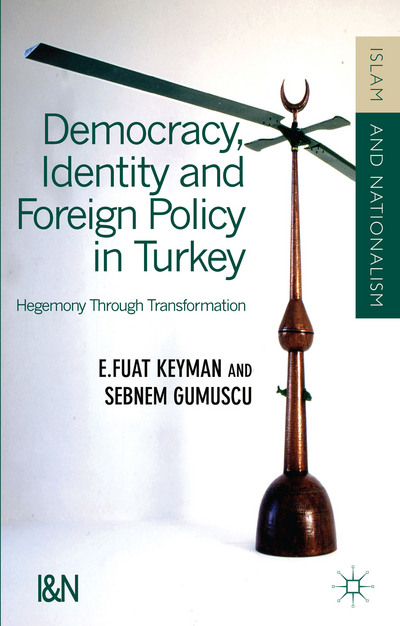
In recent years there has been an upsurge of interest in Turkey's ability to create a secular, constitutional democracy within a predominantly Muslim population. Remaking Turkey provides a comprehensive and detailed account of how Turkey has achieved the possibility of modernity and democracy in a Muslim social setting, as well as the important problems and challenges confronting this achievement. Turkey has demonstrated that, as an alternative modernity and a significant historical experience of the coexistence between Islam and democratic modernity in a secular political structure, it could make an important contribution to the most needed democratic global governance for the creation of a secure, just, and peaceful world. Remaking Turkey starts its investigation with an analysis of the Ottoman legacy, then proceeds by focusing on identity-based conflicts and civil, economic, and global processes, each of which have brought about significant challenges to modernity and democracy in Turkey. It concludes with an account of the recent changes and transformations that have given rise to the process of "remaking Turkey." In this way, editor E. Fuat Keyman presents a political theory-based approach to Turkish modernity and its recent changing formation, creating an original study of contemporary Turkey.

.
Rowman & Littlefield Publishers, Inc.

October 2007

Editor: E. Fuat Keyman

Table of Contents

Foreword Fred Dallmayr xi
Acknowledgments xiii

Introduction: Modernity and Democracy in Turkey E. Fuat Keyman xv

Ottoman Presence

Ottoman Awqaf, Turkish Modernization, and Citizenship Engin F. Isin 3

Reflections of European Self-images in Ottoman Mirrors Ash Cirakman 17

Problematizing Turkish Modernity

Laiklik and Turkey's "Cultural" Modernity: Releasing Turkey into Conceptual Space Occupied by "Europe" Andrew Davison 35

From Culture of Politics to Politics of Culture: Reflections on Turkish Modernity Hasan Bulent Kahraman 47

The Public Sphere and the Question of Identity in Turkey Feyzi Baban 75

The Question of Recognition

Defensive and Liberal Nationalisms: The Kurdish Question and Modernization/Democratization Murat Somer 103

A Legitimate Restriction of Freedom? The Headscarf Issue in Turkey Murat Borovali Omer Turan 137

Globalization, Modernization, and Democratization in Turkey: The Fethullah Gulen Movement Berrin Koyuncu Lorasdagi 153

The Anatomy of Civil Society in Turkey: Toward a Transformation Ahmet Icduygu 179

Amongst Other Nations

Reconceptualizing Center Politics in Post-1980 Turkey:Transformation or Continiuty? Aylin Ozman Simten Cosar 201

Turkey, September 11, and Greater Middle East Bulent Aras 227

Turkey and European Integration: Toward Fairness and Reciprocity Senem Aydin Duzgit E. Fuat Keyman 245

Figures and Tables 259

About the Contributors 263


.
Barnes & Noble
.

Monday, April 14, 2008

Science and Religion, 400 B.C.-A.D. 1550: From Aristotle to Copernicus

Edward Grant. Science and Religion, 400 B.C.-A.D. 1550: From Aristotle to Copernicus. Greenwood Guides to Science and Religion Series. Westport: Greenwood Press, 2004.
.
Reviewed by: Anna Marie Roos, Wellcome Unit, Oxford University.
Published by: H-Ideas (October, 2007)
.
Objective and Subjective Insights: Theology, Natural Philosophy, and the Medieval World View

Medievalist Edward Grant has devoted much of his career to analyzing to what extent modern scientific culture had its origins in the work of medieval theologians. Countering the popular perception that science and religion have always been at historical odds, a view promulgated by Andrew Dickson White's A History of the Warfare of Science with Theology in Christendom (1896 and still in print), Grant has convincingly demonstrated that the medieval Church was favorably disposed towards natural philosophy, using its principles in theological discussion and analysis.


Science and Religion, 400 B.C.-A.D.1550: From Aristotle to Copernicus is a lucid and erudite synthesis of Grant's past work. Part of the Greenwood Guides to Science and Religion, this volume is designed as an introduction to laymen and students so they might understand how religious traditions from throughout the globe have interacted with scientific disciplines. Hence, Grant devotes the last chapter of his piece to an erudite consideration of the relationships between science and religion in Byzantium as well as in the medieval Islamic world. The books in the series also provide primary source documents, an annotated bibliography, and a timeline of significant events. As a testament to its popularity for history of science pedagogy, Grant's particular volume has also been republished in paperback by John Hopkins University Press (2006).


Grant begins his largely successful survey with the claim that the "real beginnings of science and religion commenced with Plato and his student Aristotle" (p. 1). Although one could argue that the pre-Socratics in Miletus began such discourse, Grant is right to devote much of the first part of his work to Aristotle's overweening influence in the science-religion dialogue. Aristotle's conception of the Prime Mover which ultimately caused all interaction and change by being an object of desire and love, the Stagyrite's spatial and material distinction between the heavenly and sublunar realms, and his teleological cosmos were all part of a metaphysics that became a "dominant analytical tool" when applied to the Christian God in late antiquity and the early Middle Ages (p. 19). Particularly strong is Grant's overview in chapter 2 of the sheer scope of Aristotle's corpus of work as well as his techniques for analyzing philosophical problems.


Grant then analyzes early Christianity, demonstrating that the early Church fathers studied natural philosophy largely to comprehend the Christian faith, rather than for the sake of knowledge itself. Natural philosophy was a handmaiden to theology. Since God had "created the world as an essentially self-operating entity" functioning by its own laws, it was thought "the mind must penetrate nature to find God" (p. 135). Grant takes the time and care to introduce students to lesser-known theologians such as Justin Martyr, Clement of Alexandria, and John of Damascus, and recounts their attempts to reconcile pagan Greek philosophy with Christianity, rather than just jumping ahead to St. Augustine and his assimilation of Neo-Platonism with Christianity.


In chapter 4, there is also an excellent section on early hexameral literature (commentary on the six days of creation). Grant notes that the problems concerned with the creation of light in the first day (optics), the role of astronomy and astrology in the events of day two, and meteorological analysis of the third day when God made the elements and sublunar region demonstrate the use of hexameral literature as a important and logical means for theologians to discuss natural philosophy. Further, Grant's explanation of why logic became a major subject of study in the eleventh century, his analysis of the extent to which logic was applied to medieval questions of divine revelation, and the role logic played in later struggles between science and religion is also particularly noteworthy. Undergraduates reading this will understand what questiones, scholasticism, and the sententiae of Peter Lombard were all about, mostly likely to the great relief of their instructors.


After a brief discussion of the Latin encyclopedists in the fifth to eighth centuries, the work turns to the twelfth-century medieval Renaissance. As this is a work of science and religion, it is natural that Grant would concentrate upon medieval scholasticism and the rise of universities, as well as the influx of Greco-Arabic natural philosophy and the bearing it had on theological deliberations. However, in his contextual section for the twelfth century, I was a bit surprised that there was little discussion of technological innovations other than the horse collar and three-field system of crop rotation. Since one of its book's purposes is to show the harmony of medieval philosophy and religion with the study of the natural world, it couldn't hurt to mention that medieval engineers created innovations such as the water wheel and water pumps, the lateen sail, or most importantly, the mechanical clock. The mechanical clock was thought to have been invented in 996 to call monastic brethren to prayer by Brother Gerbert, later Pope Sylvester II (999-1003 A.D.), in itself a nice confluence of applied sciences and religious purpose.


I was, however, pleased to see a thorough section describing the work of what Tina Stiefel has termed the "impious men" of the twelfth century--William of Conches, Thierry of Chartres, and Adelard of Bath.[1] This trio attempted to create a rational methodology for the investigation of nature well before the appearance in the West of the Aristotelian corpus and the university. When Aristotle did become part and parcel of the medieval university, their methodology contributed to powerful changes in the relationship between science and religion in the following two centuries, the subject of the masterfully written chapters 6 and 7.


In the thirteenth century, the extensive application of logic and region in the new universities to divine questions produced tensions between faculties of arts and theology in the medieval university, as natural philosophy became more than theology's handmaiden. Utilizing the 1277 papal condemnation of heretical opinions at the University of Paris as a backdrop, Grant shows how the condemned precepts included ideas of the eternity of the world, and limitations on God's power. These precepts reflected the natural philosophers' use of pagan philosophy and reasoned speculation about creation, both of which were seen as threatening theology's primacy as "queen of the sciences." As Grant astutely comments, "The thirteenth century laid a foundation for the interrelations between science and religion in the fourteenth and fifteenth centuries…. Theology and the power of the church were sufficient to curb and limit the ambitions of the arts masters, who sought … to give free reign to their efforts to interpret the physical cosmos in straightforward Aristotelian terms, unencumbered by theological restrictions and limitations. As the dust settled in the fourteenth century, it became obvious that theologians had an enormous degree of latitude to use natural philosophy … as they pleased in their theological treatises…. By contrast, arts masters usually sought to avoid introducing theology into their commentaries and questions on the books of Aristotle's natural philosophy" (p. 189).


Using examples from his previous work, Grant analyzes the treatises of Jean Buridan to show the limitations arts faculty in the thirteenth century experienced in their speculative work, sometimes with unexpected consequences.[2] If God could indeed do anything in his power, Buridan reasoned God could create a vacuum within or outside of the world, despite Aristotle's denial of the possibility. Albert of Saxony also speculated if a "body could move in a vacuum that God had supernaturally created," which led other scholars such as Nicolas Oresme and Thomas Bradwardine to consider rectilinear motion as an absolute motion independent of place (p. 196). In a lovely example of the interaction of science and religion, Grant demonstrates to what extent the condemnation of 1277 had unexpected effects on the development of physics.


As the fourteenth century progressed however, the restrictions of the 1277 condemnation did not last. Theology became more of an analytic discipline, using the logical methods of the natural philosophers. Interest in divine infinity was analyzed using tools concerned with the infinite divisibility of a mathematical continuum. Grosseteste's work on optics used theories of illumination to analyze the intensification of grace, and the Mertonian school at Oxford in the 1330s and 1340s "measured" subjective qualities like justice and honor quantitatively.[3] The one area of theology closed to such analysis was that related to revelation, such as the Trinity and the Eucharist. Their inherent paradoxes were regarded beyond the reach of reason and logic.


From the thirteenth to the fifteenth centuries, the revelations of Holy Scripture and where they contradicted observed natural phenomena were also accommodated, the mysteries as the Bible seen as allegorical. Despite the later clash (Grant calls it a "debacle") in the seventeenth century over Galileo's adoption of Copernicus' heliocentrism in contradiction to biblical geocentrism, medieval philosophers had little interest to "convert the Bible into a book that allegedly contained the secrets of nature and its operations" (p. 224). So far, so good. In these areas of Grant's expertise, this book shines and demonstrates to its readers the interaction between science and religion in the medieval period with erudition. But I did note a few omissions. First of all, Copernicus and his significance are given very short shrift (approximately six to eight sentences scattered throughout the book). Perhaps the Copernican debt to earlier belief systems such as the cult of Pythagoras and Neo-Platonism could have been covered more thoroughly to foreshadow the growing influence of Plato in the Renaissance. This approach may have not fit into as neat of a pattern or argument, but the volume does claim to end with the Copernican hypothesis which perhaps should do more than mark the "beginning of the end for the medieval worldview" (p. 1).


Secondly, the choice of primary sources, while offering some excellent selections, starts with Roger Bacon and ends with Nicolas Oresme, and could have been a bit more comprehensive. If the book is used as a pedagogical tool, primary sources from ancient world and the beginnings of the early modern period should be represented.


Third, Grant then claims in his last chapter that the division of the medieval university into faculties of arts and theology foreshadowed the later division in Western societies of church and state, and that was a very good thing for science indeed.[4] For this reader, the Galileo affair which helped precipitate this division was more of a tragedy then something that resulted in an ultimate good. As an early modernist, it seems to me that the church and state were intertwined for a very long time in a complex dialogue which resulted in both benefits and tragedies; in the human condition, it seems realistically one cannot have one without the other. Galileo was condemned by the Church being caught in the political snares of the Counter-Reformation, but he also benefited from the knowledge of its Jesuit astronomers and mathematicians. As Wallace has demonstrated, Galileo's very lecture notes from his student days at the University of Pisa had as their source the lectures of the Jesuits at the Collegio Romano, considered the best in their field.[5] Copernicus, who inadvertently started the whole firestorm, was a church canon, whose motivation for his science was often frankly quite mystical and precipitated a watershed in thought. In the early modern period, the sense of awe at nature and a celebration of scientific discovery were not incompatible with a religious worldview, nor is that necessarily the case now. But that is getting into a wholly different debate outside the scope of this review.[6]


Nonetheless Grant's book is very fine and a pleasure to peruse. For those who want or need to understand the fascinating and often surprising world of Western medieval religion and its interaction with natural philosophy, this book is the one to read. I highly recommend it.


Notes

[1]. Tina Stiefel, "'Impious Men'": Twelfth-Century Attempts to Apply Dialectic to the World of Nature," Annals of the New York Academy of Sciences 441, no. 1 (1995): 187-204

[2]. Edward Grant, Much Ado about Nothing: Theories of Space and Vacuum from the Middle Ages to the Scientific Revolution (Cambridge: Cambridge University Press, 2004).

[3]. Grant here relies on the work of Edith Sylla, "Medieval Quantifications of Qualities: The "Merton School," Archive for History of Exact Sciences 8, nos. 1-2 (1971): 9-39.

[4]. Grant's conclusion seems a variation of Steven Jay Gould's concept of science and religion being described as "non-overlapping magisteria" (NOMA), which each concerns themselves with fundamentally separate aspects of human experience, coexisting peacefully when each stays within its own domain.

[5]. William A. Wallace, Galileo and his Sources: The Heritage of the Collegio Romano in Galileo's Science (Princeton: Princeton University Press, 1984); James M. Lattis, Between Copernicus and Galileo: Christoph Clavius and the Collapse of Ptolemaic Cosmology (Chicago: University of Chicago Press, 1994).

[6]. For the recent state of affairs, see George Johnson, "A Free-for-All on Science and Religion," New York Times, November 21, 2006.

.

Monday, March 31, 2008

A Brief History of the Late Ottoman Empire


M. Sükrü Hanioglu, Princeton University
Princeton University Press, 2008
Introduction
[HTML] or [PDF format]

.

At the turn of the nineteenth century, the Ottoman Empire straddled three continents and encompassed extraordinary ethnic and cultural diversity among the estimated thirty million people living within its borders. It was perhaps the most cosmopolitan state in the world--and possibly the most volatile. A Brief History of the Late Ottoman Empire now gives scholars and general readers a concise history of the late empire between 1789 and 1918, turbulent years marked by incredible social change.

.

Moving past standard treatments of the subject, M. Sükrü Hanioglu emphasizes broad historical trends and processes more than single events. He examines the imperial struggle to centralize amid powerful opposition from local rulers, nationalist and other groups, and foreign powers. He looks closely at the socioeconomic changes this struggle wrought and addresses the Ottoman response to the challenges of modernity. Hanioglu shows how this history is not only essential to comprehending modern Turkey, but is integral to the histories of Europe and the world. He brings Ottoman society marvelously to life in all its facets--cultural, diplomatic, intellectual, literary, military, and political--and he mines imperial archives and other documents from the period to describe it as it actually was, not as it has been portrayed in postimperial nationalist narratives. A Brief History of the Late Ottoman Empire is a must-read for anyone seeking to understand the legacy left in this empire's ruins--a legacy the world still grapples with today.

.

M. Sükrü Hanioglu is professor of Near Eastern studies at Princeton University. He is the author of Preparation for a Revolution and The Young Turks in Opposition.

.

Endorsements:

"Without doubt the best history of the development of political ideas in the late Ottoman Empire. Haniogluu situates this history of ideas in the context of the political and diplomatic history of the empire as well as in the history of European political thought, of which he demonstrates a deep knowledge."--Erik J. Zürcher, author of Turkey: A Modern History

.

"A significant contribution, not only to the historiography of the late Ottoman Empire but also to the field of comparative studies of empires."--Fikret Adanir, coeditor of The Ottomans and the Balkans

.

Table of Contents:

List of Figures ix
Acknowledgments xi
Note on Transliteration, Place Names, and Dates xiii
Introduction 1
Chapter 1: The Ottoman Empire at the Turn of the Nineteenth Century 6
Chapter 2: Initial Ottoman Responses to the Challenge of Modernity 42
Chapter 3: The Dawn of the Age of Reform 55
Chapter 4: The Tanzimat Era 72
Chapter 5: The Twilight of the Tanzimat and the Hamidian Regime 109
Chapter 6: From Revolution to Imperial Collapse: The Longest Decade of the Late Ottoman Empire 150
Conclusion 203
Further Reading in Major European Languages 213
Bibliography 217
Index 231

.

Subject Areas:

http://press.princeton.edu/titles/8639.html
.

Friday, March 28, 2008

Pearls of Wisdom (VII) / Mevlana Rumi

The Rumi: The Card and Book Pack by Eryk Hanut, Michele Wetherbee, Michele Wetherbee, Michele Wetherbee (Tuttle Publishing, 2006).
.
Synopsis (Barnes & Noble)
Thirteenth-century Persian poet Rumi remains one of the world's most popular mystics and poets; his fans include PBS' Bill Moyers, among others. Tuttle is proud to offer a beautifully produced package of Rumi's peerless wisdom, in a new translation text and 54 interactive cards. The book explores the history of Rumi and his career as a spiritual instructor and sage. The colorful cards are divided into six families-birth, love, ordeal, transformation, warnings, and rewards-and come with interpretations and instructions for using them for meditation, inspiration, and to answer life's questions. Attractive, handy, and easy-to-use, Rumi: The Card and Book Pack is a fun, enlightening way to arrive at greater self-knowledge through the insightful words of one of the greatest sages of all time. Eryk Hanut is the author of Perfume of the Desert: Inspirations from Sufi Wisdom, and co-author of Mary's Vineyard: Daily Meditations, Readings and Revelations. His articles have appeared in many national publications, including Yoga Journal, Body, Mind, & Spirit, and the Los Angeles Times. Michele Wetherbee, a resident of Petaluma, California was formerly Creative Director at HarperCollins San Francisco and art director for Giftworks, a division of Chronicle Books.

.
Open your heart, and you will hear the lutes of the Angels.
.
The mirror of the heart must be polished constantly Before you can see clearly in it Good and Evil.
.
It is certain that an atom of goodness on the path of faith is never lost.
.
Happiness is more precious than wealth; May millions of mercies rain on your dancing!

Look for the soul, you become soul; Hunt for the bread, you become bread. Whatever you look for, you are.

You want everything to be yours? Become nothing to yourself and all things.
.
Whoever doesn’t show himself humble today Will tomorrow be humiliated like Pharaoh.
.
The more you strive to reach the place of Splendor, The more the invisible Angels will help you.
.
After despair, many hopes flourish Just as after darkness, Thousands of Suns open and Start to shine.
.
Before death takes what has been given to you, you must give away everything you can give.
.
Put your trust in him who gives Life and Ecstasy. Don’t mourn what doesn’t exist; Cling to what does.
.
How can victory be won without spiritual war and patience? Give proof of patience; Faith is the key to joy.
.
If you know how to be patient, He’ll offer you the seat of honor; He’ll show you a hidden way that no one will know.
.
.
If it is love you are looking for, Take a knife and cut off the head of fear.
.
Through Love, disaster becomes good fortune. Through love, a prison becomes a garden.
.
Love has come to rule and transform; Stay awake, my heart, stay awake.
.
Do not call a cup Sea; Do not call mad the sage of Love.
.
Eat on and on, you lovers, at Eternity’s table; Its feast is forever; And spread out for you.
.
.
Picture: flickr.com
.

Monday, March 03, 2008

A Small Treatise on the Great Virtues

(Barnes & Noble Review)

An utterly original exploration of the timeless human virtues and how they apply to the way we live now, from a bold and dynamic French writer.

In this graceful, incisive book, writer-philosopher André Comte-Sponville reexamines the classic human virtues to help us under-stand "what we should do, who we should be, and how we should live." In the process, he gives us an entirely new perspective on the value, the relevance, and even the charm of the Western ethical tradition.


Drawing on thinkers from Aristotle to Simone Weil, by way of Aquinas, Kant, Rilke, Nietzsche, Spinoza, and Rawls, among others, Comte-Sponville elaborates on the qualities that constitute the essence and excellence of humankind. Starting with politeness -- almost a virtue -- and ing with love -- which transcs all morality -- A Small Treatise on the Great Virtues takes us on a tour of the eighteen essential virtues: fidelity, prudence, temperance, courage, justice, generosity, compassion, mercy, gratitude, humility, simplicity, tolerance, purity, gentleness, good faith, and even, surprisingly, humor.Sophisticated and lucid, full of wit and vivacity, this modestly titled yet immensely important work provides an indispensable guide to finding what is right and good in everyday life.


Kirkus Reviews

An energized discussion of essential virtues for everyday living, by a young French philosopher. Comte-Sponville (Sorbonne), author of scholarly philosophy texts, targets a wider contemporary audience with this title, so far translated into 19 languages. His premise is elegant: a linked series of 18 essays on the virtues most consistently explored and advocated in world philosophy. Roughly speaking, he begins with virtues that are exterior and personal (politeness, fidelity, prudence, temperance), moves through necessary "social" virtues (courage, justice, generosity, compassion, mercy), to more ethereal, "Zen"-like qualities (gratitude, humility, simplicity, tolerance), and on to those that permit the previous virtues to enhance society (purity, gentleness, good faith, humor, and love). His exploration of each virtue is detailed and limber, reliant both on the work of his predecessor philosophers (Aristotle and Plato, Thomas Aquinas and Spinoza, Simone Weil) and on his own hypothetical situations to "test" such virtues. For example, he frequently considers the Third Reich as a society that burnished essential values in the context of perverting them, noting that a polite Nazi is arguably crueler than a brutish one. Comte-Sponville relishes challenging the paradoxes inherent in contemporary mores, as in his assertion that "universal tolerance would also be self-contradictory in practical terms and thus not just morally reprehensible but also politically doomed." Elsewhere, he explores the fine distinctions that are obliterated by monolithic conceptions of virtue, William Bennett-style, as regarding "Purity," which he demonstrates does not exclude the range of human sexuality,evident in Lucretius' conception of pura voluptas, "pure pleasure." Throughout, Comte-Sponville captures (and sometimes confounds) our attention with a wry, prickly tone, expanding the understanding of how philosophy addresses human traits, and forcing us to confront our social behavior relative to our highest (and lowest) impulses. An effervescent primer of the morally examined life.


André Comte-Sponville
is one of the most important and popular of the new wave of young French philosophers. Now in his early forties, he teaches at the Sorbonne and is the author of five highly acclaimed scholarly books of classical philosophy. A Small Treatise on the Great Virtues spent fourteen months on the French bestseller list and is being translated into nineteen languages. He lives in Paris.


Full-text of the book is available at Google, click here.

Friday, February 01, 2008

Sufism: The Formative Period